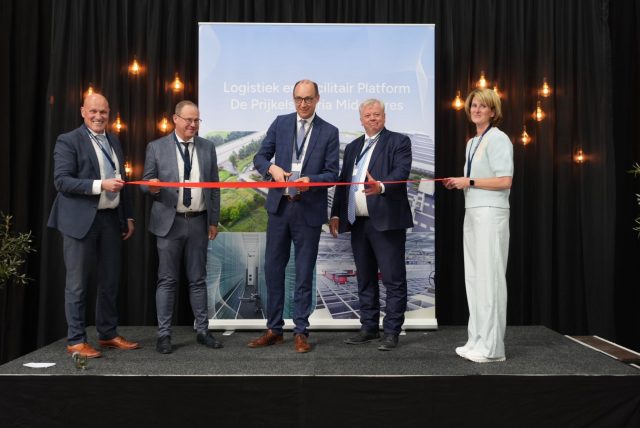
Jan Blontrock, co-CEO; Christophe Mouton, CEO; Deputy Prime Minister Vincent Van Peteghem; Pascal Verdonck, chair of the board; and Isabel Verniers, CFMO, at the opening of the new Maria Middelares Logistics Center.

When we think of healthcare innovation, our minds naturally drift to high-tech operating theaters, breakthrough clinical treatments, or advanced bedside technologies. Yet, some of the most radical transformations occur entirely behind the scenes. At the healthcare group Maria Middelares in Belgium, a visionary shift in organizational infrastructure is proving that, to strengthen patient care, you must first transform the supply chain.
At Maria Middelares in Belgium, this understanding led to the creation of a new Logistics and Facility Platform at De Prijkels in Nazareth-De Pinte, approximately 15 km away by road from the hospital’s clinical sites. The platform centralizes warehouse and distribution-pharmacy operations outside the hospital sites, creating a more automated, integrated, and traceable supply chain designed to support safer, more efficient care. The model is not entirely new in healthcare. However, an automated pharmacy of this kind is unique in Europe. Its significance lies in how Maria Middelares is applying the model to rethink what belongs inside the hospital and what can be organized at greater scale.
Jan Blontrock, co-CEO; Christophe Mouton, CEO; Deputy Prime Minister Vincent Van Peteghem; Pascal Verdonck, chair of the board; and Isabel Verniers, CFMO, at the opening of the new Maria Middelares Logistics Center.
When Maria Middelares began planning its new hospital building, which opened in 2015, its leadership was already thinking about the future use of hospital space. Every square meter inside a hospital is expensive and strategically important. Over time, functions such as warehousing, logistics, and pharmacy distribution could be moved outside the hospital, allowing high-value clinical space to be used for patient care.
That long-term thinking became more urgent as the organization continued to grow. Like many healthcare providers, Maria Middelares faced increasing demand, pressure on clinical space, and the need to operate more efficiently amid workforce constraints.
A unique opportunity emerged when an external site became available near the organization’s clinical sites. Rather than outsourcing logistics and pharmacy distribution to an external provider, Maria Middelares made a different choice: to “outsource it to itself.” The result was a centralized logistics and pharmacy platform designed to improve efficiency, strengthen safety, support sustainability, and enable future collaboration.
The De Prijkels platform brings together a central warehouse and a distribution pharmacy in one integrated system. The true brilliance and added value of De Prijkels lie not only in its advanced robotics but also in how it seamlessly bridges the gap between industrial logistics and healthcare precision.
Before the new model, medication distribution involved multiple manual steps. A physician prescribed medication, the pharmacist reviewed it, pharmacy staff manually picked it, and medication was often prepared several days in advance for the ward. If a patient moved to another ward, was discharged, or no longer needed the medication, unused medication had to be returned to the pharmacy, creating additional logistical work, avoidable waste, and more opportunities for error.
The new, technologically integrated workflow eliminates these bottlenecks through a fully closed-loop medication process:
Smart Unit-Dosing: At the central hub, bulk medication is received, scanned, and automatically repackaged into single unit doses. Each dose receives a unique QR code that records the medication name, serial number, and expiration date.
Point-of-Care Automation: On the hospital wards, intelligent automated dispensing cabinets (such as Pyxis) connect directly to the electronic patient files.
Error-Free Dispensing: Once a physician prescribes a medication and a pharmacist validates it digitally, the ward cabinet unlocks only the specific compartment holding that precise dose.
This automated network provides end-to-end traceability from the supplier to the patient’s bedside.
Building the platform required the team to draw on industrial logistics expertise while adapting it to the realities of healthcare. Hospital logistics includes patient-specific medication flows, pharmacy regulations, medical equipment requirements, and strict safety standards, making collaboration between logistics professionals, pharmacists, clinicians, engineers, technology partners, and leadership essential.
The implementation also required breaking down internal silos. Logistics and pharmacy had to work as one connected system while preserving distinct professional roles: pharmacists focus on clinical pharmacy and medication validation, nurses focus on patient care, and logistics teams ensure that the right materials and medications are available at the right time and in the right place. As Maria Middelares’ leadership emphasized, this is not simply about automation. It is about organizational and process change, with technology serving as an enabler.
Although the platform has only recently started operating and a fuller analysis is expected toward the end of 2026, Maria Middelares is already able to identify several areas of impact:
The De Prijkels platform demonstrates that healthcare transformation does not always begin with a new clinical device or treatment. Sometimes it begins with a fundamental question: What should a hospital actually be used for?
For Maria Middelares, the answer is clear. The hospital should be focused on care, intervention, and clinical decision-making. The processes that support care should be designed around efficiency, safety, traceability, and scale.
The platform also points to a wider opportunity. Supply chain and logistics are areas where hospitals do not always need to remain fully autonomous. By scaling logistics and building shared platforms, healthcare organizations can become more efficient, more sustainable, and better positioned to invest in clinical priorities. Greater efficiency, by definition, means higher productivity.
The De Prijkels Logistics and Facility Platform is more than a warehouse or pharmacy distribution center. It is a strategic investment in the future of hospital care.
By centralizing logistics, automating medication distribution, improving traceability and safety, reducing avoidable returns, and freeing clinical space, Maria Middelares is showing how operational change can strengthen the entire care system. In a sector where innovation is often discussed through the lens of new technologies, this project offers a grounded reminder: better care also depends on the infrastructure behind care. By centralizing infrastructure, exploiting industrial automation, and scaling logistics, the organization has unlocked a high-productivity blueprint that will undoubtedly inspire healthcare networks across Europe.


